

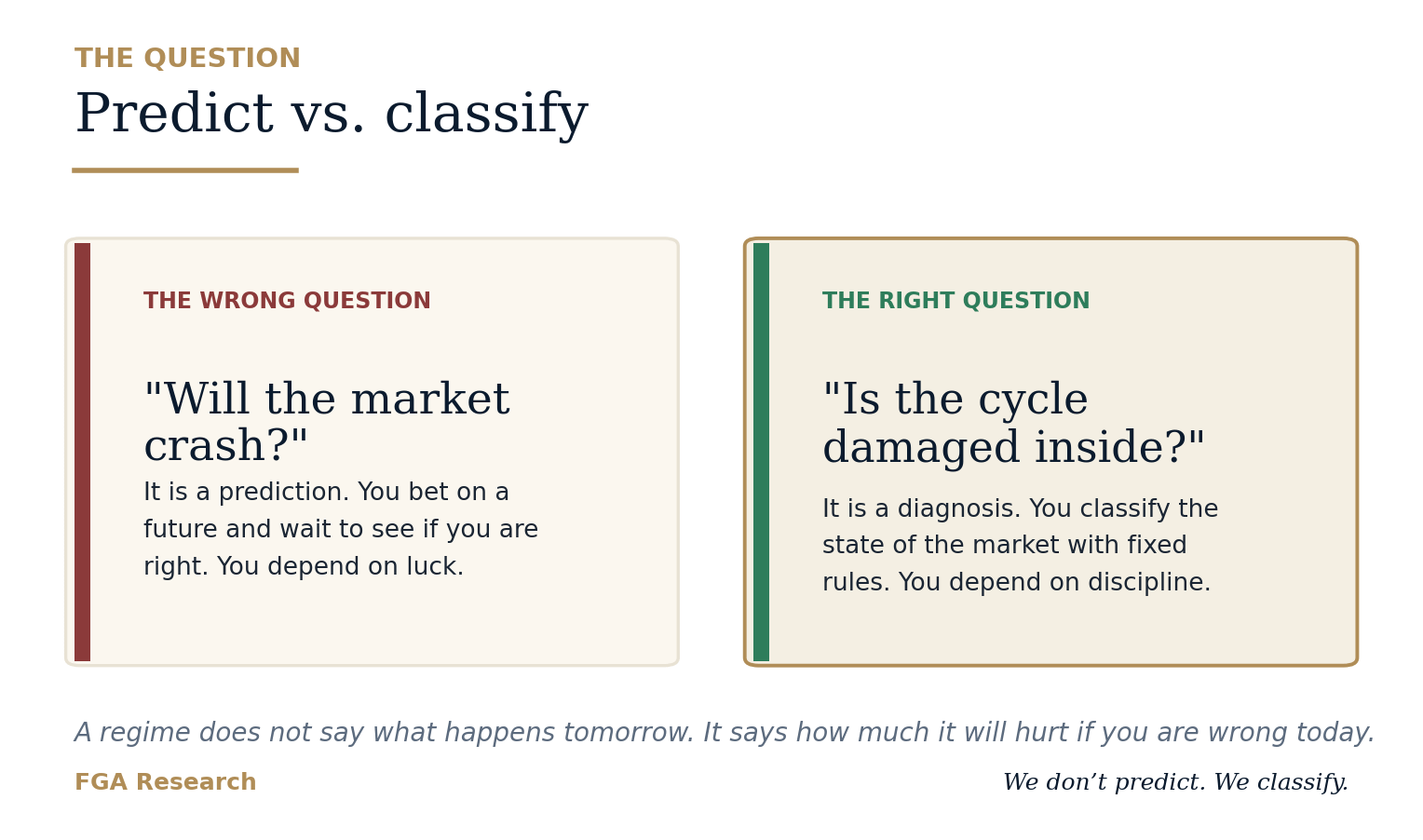
"Will the market crash?" has no useful answer, because it is a prediction. The question you can actually answer is different: is the cycle damaged inside? That one separates a drop that reverses from one that starts something — and, for protecting capital, it is the only one that matters.
It is the most repeated search every time the market shakes: "will the market crash?". And the honest answer from anyone —bank, asset manager or analyst— is always the same: nobody knows. Tomorrow’s prices aren’t written. Asking it is asking someone to guess.
But there is a second question, far less glamorous, that does have an answer. And it changes everything.
Predicting is guessing. Classifying is diagnosing.
Predicting means betting on a specific future —"it will fall in September"— and waiting to see if you’re right. You depend on luck. Classifying is different: diagnosing the state of the present with fixed rules, like a doctor who doesn’t guess when you’ll fall ill but can tell whether you’re healthy today. You depend on discipline, not fortune.
A market regime is that diagnosis: the state of the market, not its next move. And unlike a prediction, it can be verified without waiting for the future.
Why the same drop means opposite things
A 5% drop with a healthy cycle is an opportunity: the market breathes and moves on. The same 5% drop when the cycle is damaged inside can be the first step of a structural bear market. The number is identical. What changes is the terrain.
That’s why "will it crash?" is the wrong question: even if you got the "yes" right, you wouldn’t know if it’s noise or a beginning. The useful question is not whether it falls, but what state the market is in when it does.
How it’s answered: four layers
At FGA we don’t guess: we classify the regime by crossing four independent readings. None decides alone; the regime only changes when two or more turn at once.
The Warning checks whether the cycle is healthy or damaged inside (macro, corporate, markets). The Crowd reads sentiment contrarian: bottoms are made on fear. Money · the Fed measures whether the price of money pushes or brakes. FGA Macro confirms where in the cycle we are. Together they answer the right question.
In 30 seconds
🔴 "Will the market crash?" = prediction. Nobody knows.
🟡 "Is the cycle damaged inside?" = diagnosis. This one has an answer.
🟢 The same drop is noise or a chance to break depending on the regime. That’s why the diagnosis matters more than the prediction.
Every week we classify the market regime with the four layers and publish it —dated, before the outcome is known— in FGA Macro. Free, in Spanish and English.
The full framework —the four layers, the Warning and the traffic light— is in The FGA Method. And what a regime is exactly, in this piece.
Informational and educational content: dissemination of an analytical framework. Not financial advice, not a buy or sell recommendation, and containing no signals or price targets. FGA Research & Advisory. Francisco Salvador is an agent of Miraltabank, an entity regulated by the Bank of Spain.
Independence. Capital. Conviction. · FGA Research & Advisory · Est. 2006 · 33 years of study