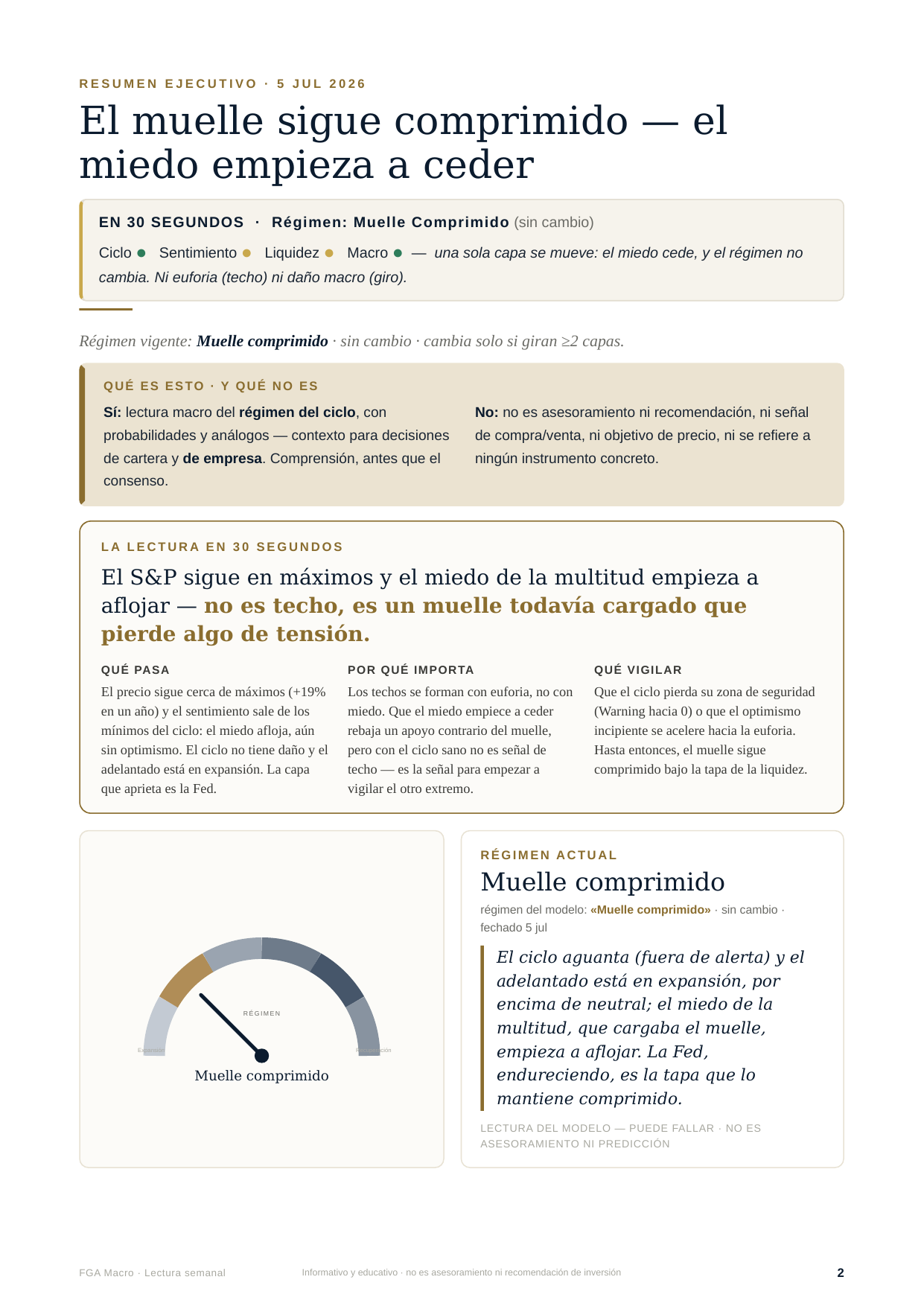
This week's verdict. The regime is still Compressed Spring — unchanged. The news is inside the layers: the crowd's fear, which had been loading the spring, is starting to ease. No euphoria (which would mark a top), no macro damage (which would mark a turn).
The S&P 500 closed the week near highs again, brushing 7,480 (about +19% over twelve months). Once again, price isn't the story. The story is in Layer 2: the fear we've been flagging for weeks has begun to ease. Our sentiment gauge is coming off its cycle lows. Careful, though — this isn't optimism arriving; caution still rules — but the spring that had been pinned to the floor for weeks is starting to release.
And last week's other spring still holds: in Layer 4, the leading indicator stays above its neutral level. It's no longer turning; it's expanding.
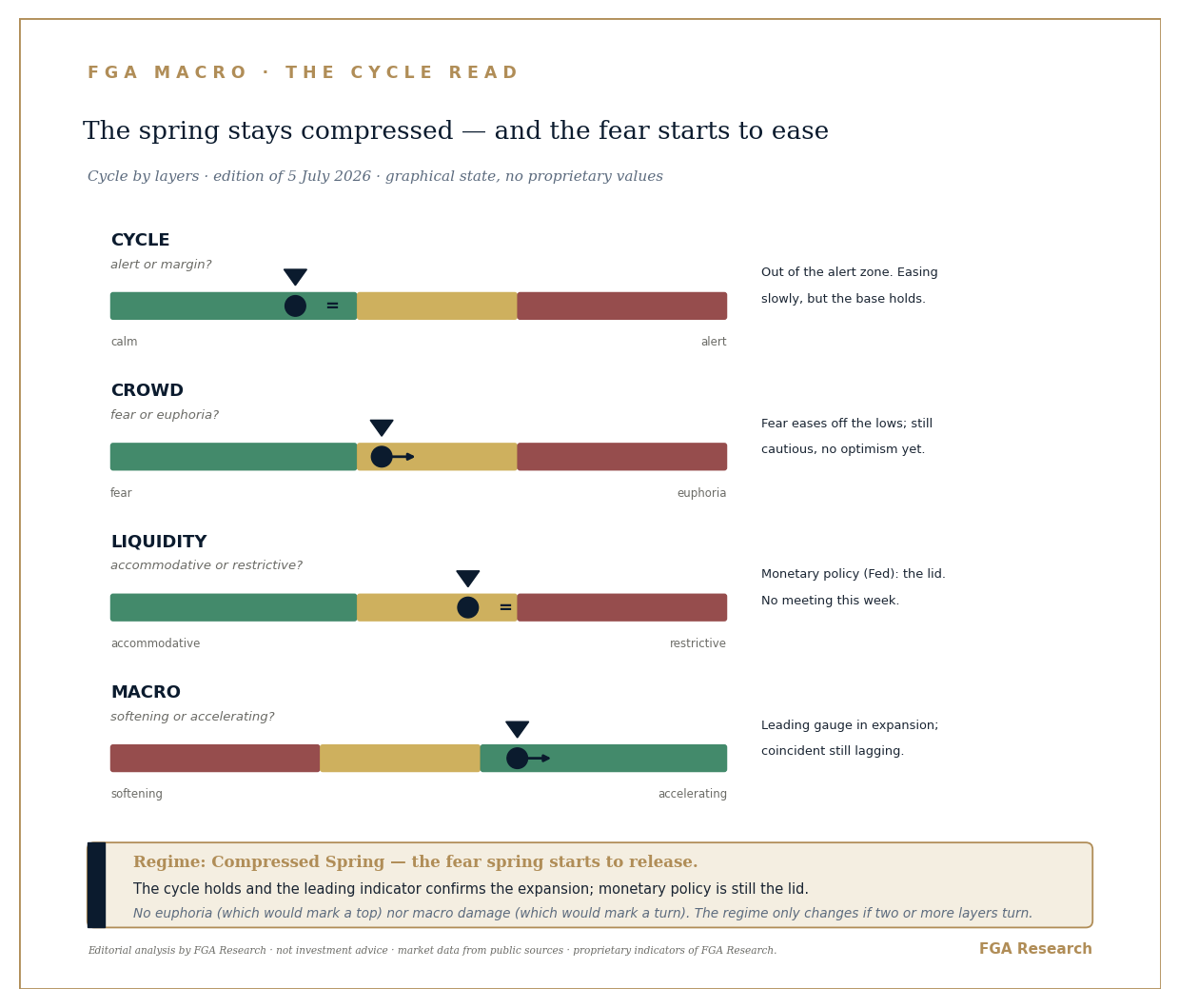
Regime: Compressed Spring. The cycle holds, the leading indicator confirms the expansion; fear starts to ease and monetary policy is still the lid.
In 30 seconds
Regime: Compressed Spring — unchanged (it only changes if two or more layers turn).
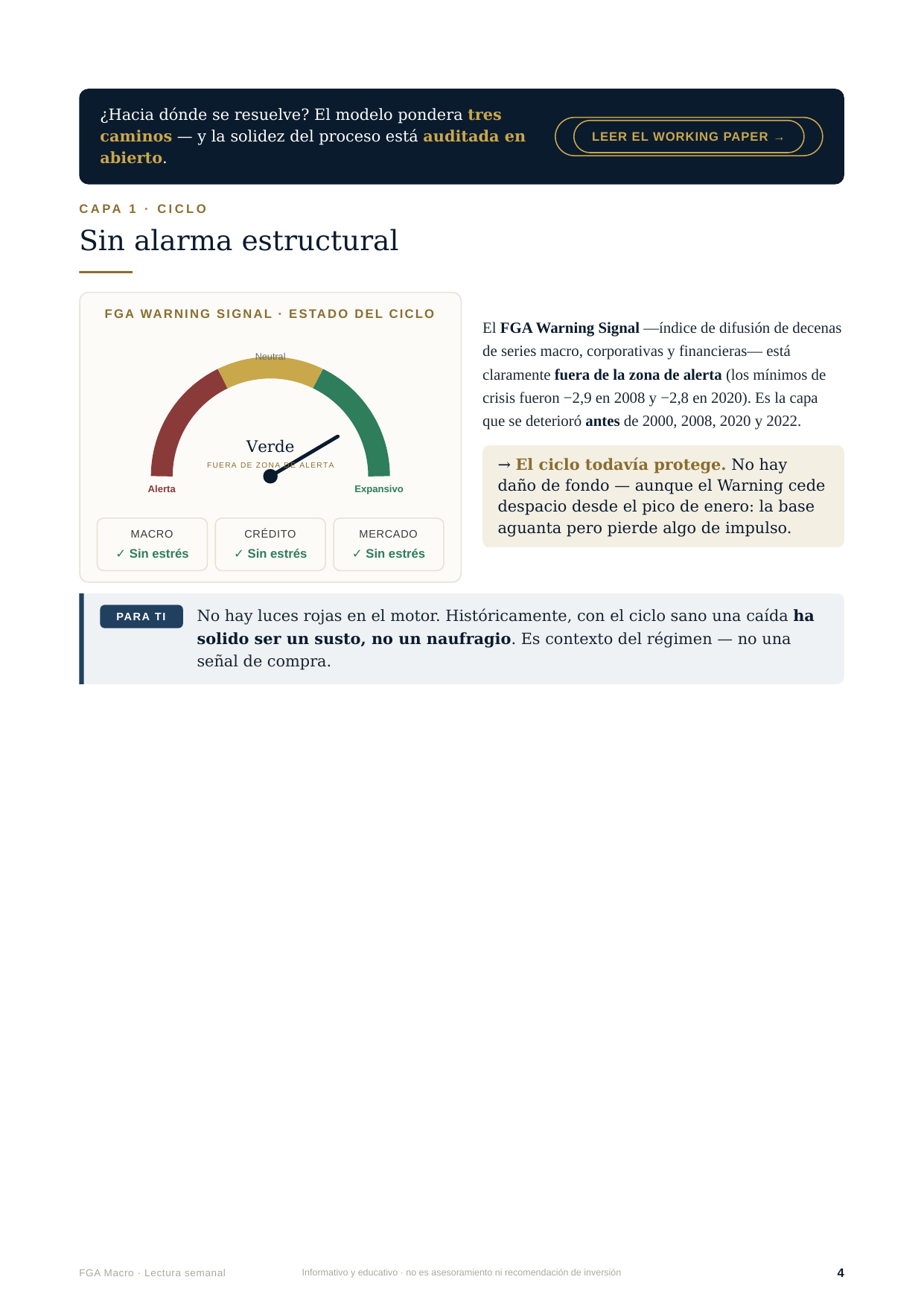
Layer 1 · Warning — 🟢 out of the alert zone; no structural damage.
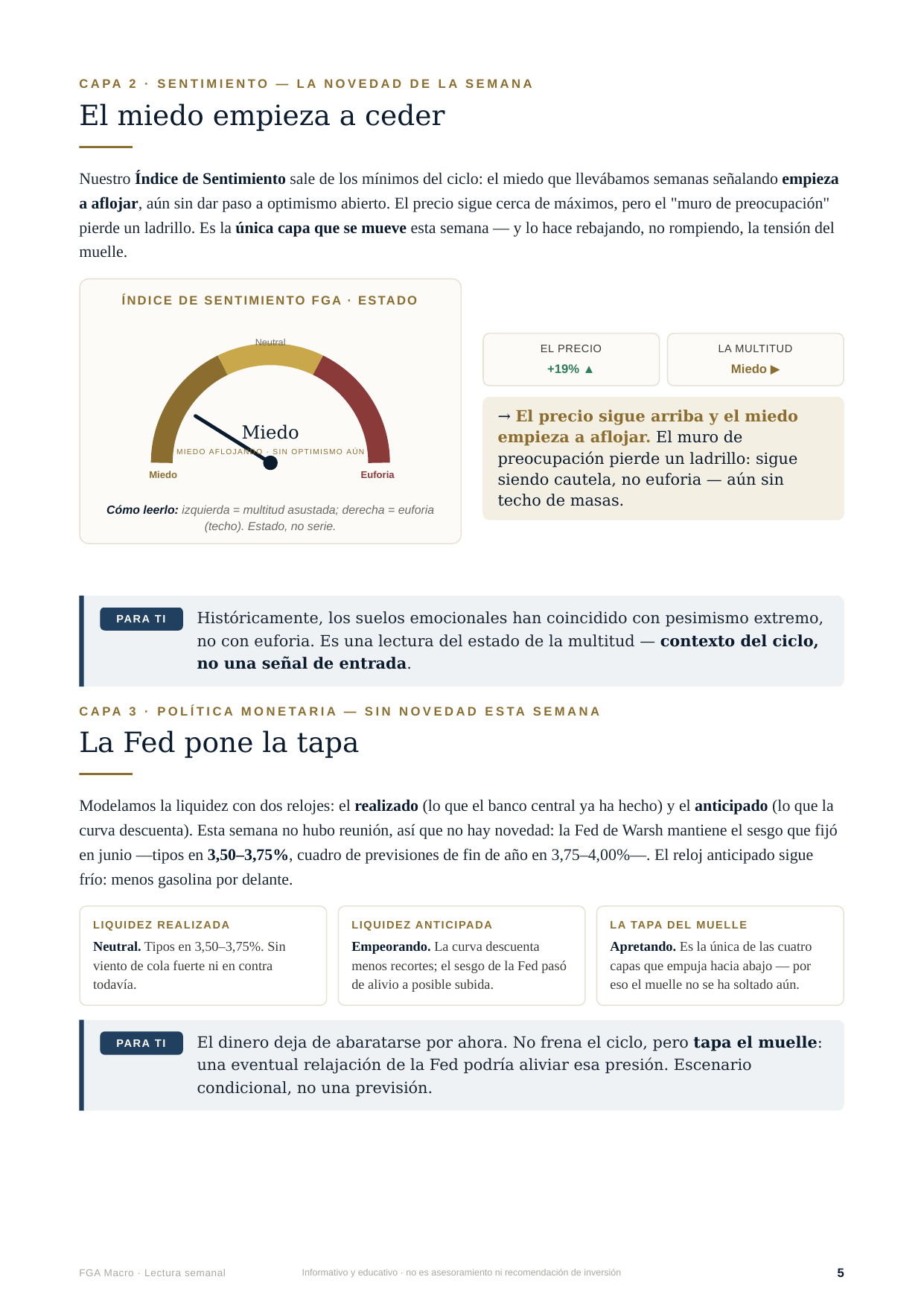
Layer 2 · Crowd — 🟡 this week's change: fear starts to ease, still short of optimism.
Layer 3 · Money (the Fed) — 🟡 monetary policy is still the lid; no Fed meeting this week.
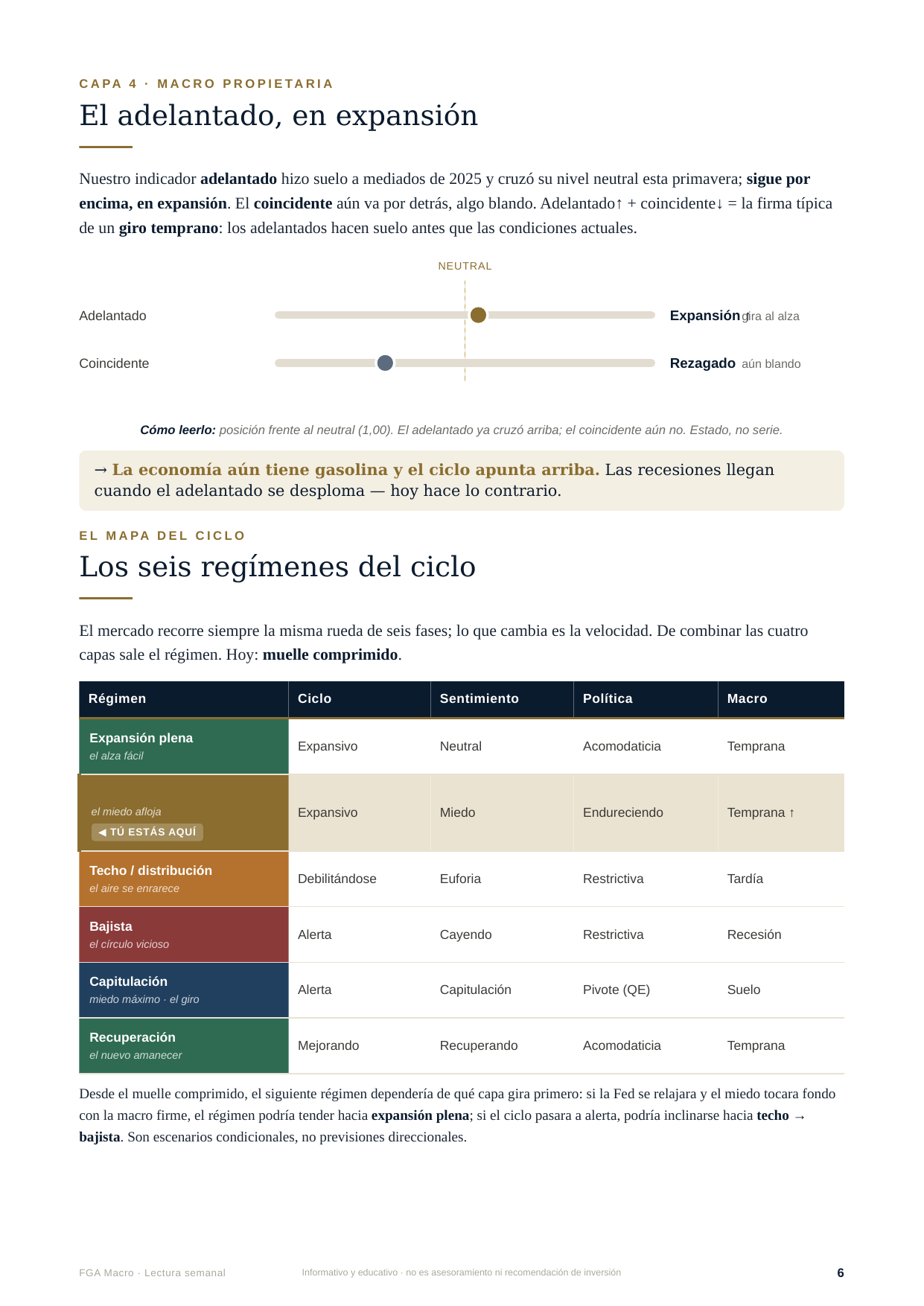
Layer 4 · FGA Macro — 🟢 the leading indicator holds in expansion, above neutral.
The so-what: only one layer moves — fear eases — so the regime doesn't change. The spring stays loaded, but with one contrarian support less. No euphoria (which would mark a top), no macro damage (which would mark a turn).
This is how we read the cycle every week: four layers, made clear. Get it free in your inbox.
This week's composite
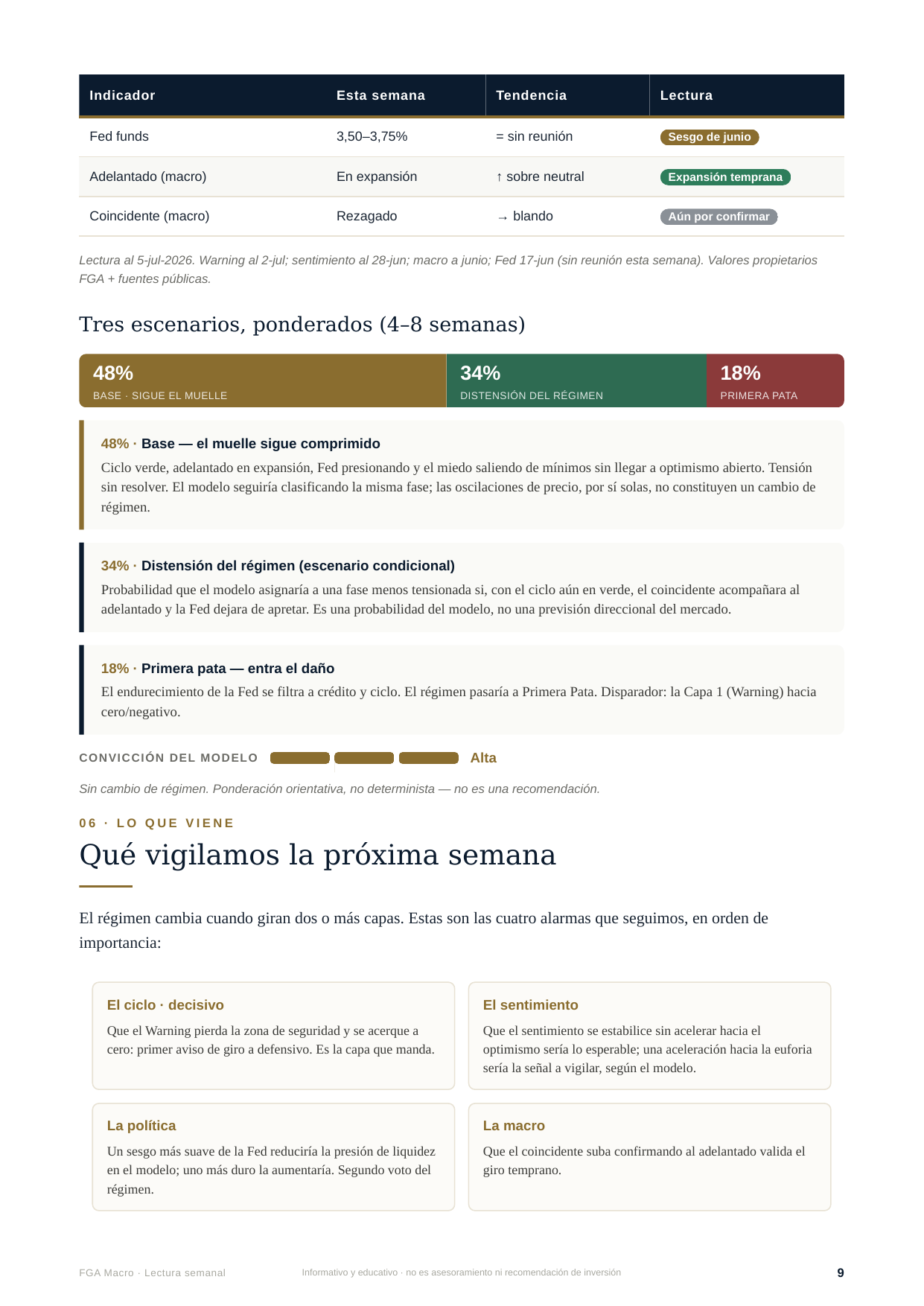
(The four-layer composite and the scenario map with probabilities are in the report gallery, at the foot of this edition.)
Regime in force: Compressed Spring. The regime only changes when two or more layers turn, and this week only one moves — sentiment. So the name doesn't change. What changes is the internal tension: one of the springs loading the move higher — the crowd's fear — is starting to ease.
The four layers, in detail
Layer 1 · Warning — 🟢 Green. The Warning Signal remains clearly out of the alert zone. Worth remembering where the real danger sits: the crisis lows were −2.9 (2008) and −2.8 (2020), and we're nowhere near them. It's easing slowly from the January peak, yes, but that's losing a little momentum, not breaking. As long as this layer stays green, this is a reset with the spring loaded, not a turn lower.
Layer 2 · Crowd — 🟡 Amber, and here's the news. For two editions we've told the "wall of worry": price at highs, a frightened crowd. Last week the first crack appeared — the professionals (very bullish advisors, active managers almost fully invested) had already gone long while retail stayed out. This week that crack widens and sentiment leaves its cycle lows. Now, careful with the word. Fear eases; it hasn't given way to optimism. We're still in caution, far from the complacency that builds tops. And the honest read is a touch uncomfortable: one of the contrarian supports loading the spring has been trimmed. Less fear, less cushion. It's not a top signal — it's the signal to start watching the other extreme.
Layer 3 · Money (the Fed) — 🟡 Amber, drifting lower. Here Layer 3 measures one specific thing: the monetary policy of central banks, above all the Fed. Not market conditions, but whether money blows with you or against you. And for now it blows against, gently. Warsh's Fed keeps the June bias, and there was no meeting this week, so no news. It's not restrictive yet; it's less accommodative. It's the lid that keeps the spring compressed. What we watch isn't what the Fed has already done, but what the curve starts to price: that forward-looking clock moves first.
Layer 4 · FGA Macro — 🟢 Green, rising. No surprises, and that's good. The leading gauge bottomed in mid-2025 and crossed its neutral level this spring; it's still above, in expansion. The coincident still lags, a little soft. Leading ahead and coincident lagging is the signature of an early expansion, not of a cycle running out. Recessions are announced the other way round: when the leading gauge collapses with the lagging stretched. That's absent today.
The verdict
Regime: Compressed Spring — with the fear spring easing. The pieces still fit. The cycle isn't broken, the leading indicator is expanding, monetary policy presses from above. The only thing moving this week is the crowd. Nothing more — but not nothing. That fear, which for weeks worked in our favour in contrarian terms, is starting to give — without yet making the jump to open optimism. The spring keeps pushing and has rope left: no euphoria (which would mark a top), no macro damage (which would mark a turn). As long as Layer 1 stays green, this is still a loaded reset.
Scenario map (model probabilities)
(The four-layer composite and the scenario map with probabilities are in the report gallery, at the foot of this edition.)
This is a regime read and its probabilities, not a recommendation or a price target.
Analogues & Bubble Watch
The pattern "intact cycle + tightening central bank + leading gauge in expansion + fear starting to ease" has useful precedents in 1994–95 (the Fed hikes, the market digests it without a recession) and 1998 (a sharp scare inside a live cycle, distinct from 1999, already late). Illustrative analogues; every cycle is different.
In the Bubble Watch, valuation still ticks ✓ —the CAPE at a historic extreme— and index concentration; they do not tick cycle, credit or the curve. Fuel yes, spark no. What's changed versus a month ago? With fear easing, that contrarian support weighs less. And that forces us to look at the other end of the board —complacency—, which until now we weren't even touching.
What we're watching this week
Warning Signal (Layer 1): if it speeds its fall toward zero, that would be the first real warning of a phase change (→ First Leg Down).
Sentiment (Layer 2): now that fear is starting to ease, the question switches sides. Does it settle into caution, or accelerate toward the optimism and euphoria that build tops? That's what's new.
Coincident (Layer 4): if it starts to rise, confirming the leading gauge, it validates the early expansion — the piece that matters most to us.
The yield curve (Layer 3, forward-looking): the first hint that the Fed will loosen the lid shows up in the curve before it shows up in rates.
We flag the day the regime changes — that's the moment of maximum value.
The proof, in the open
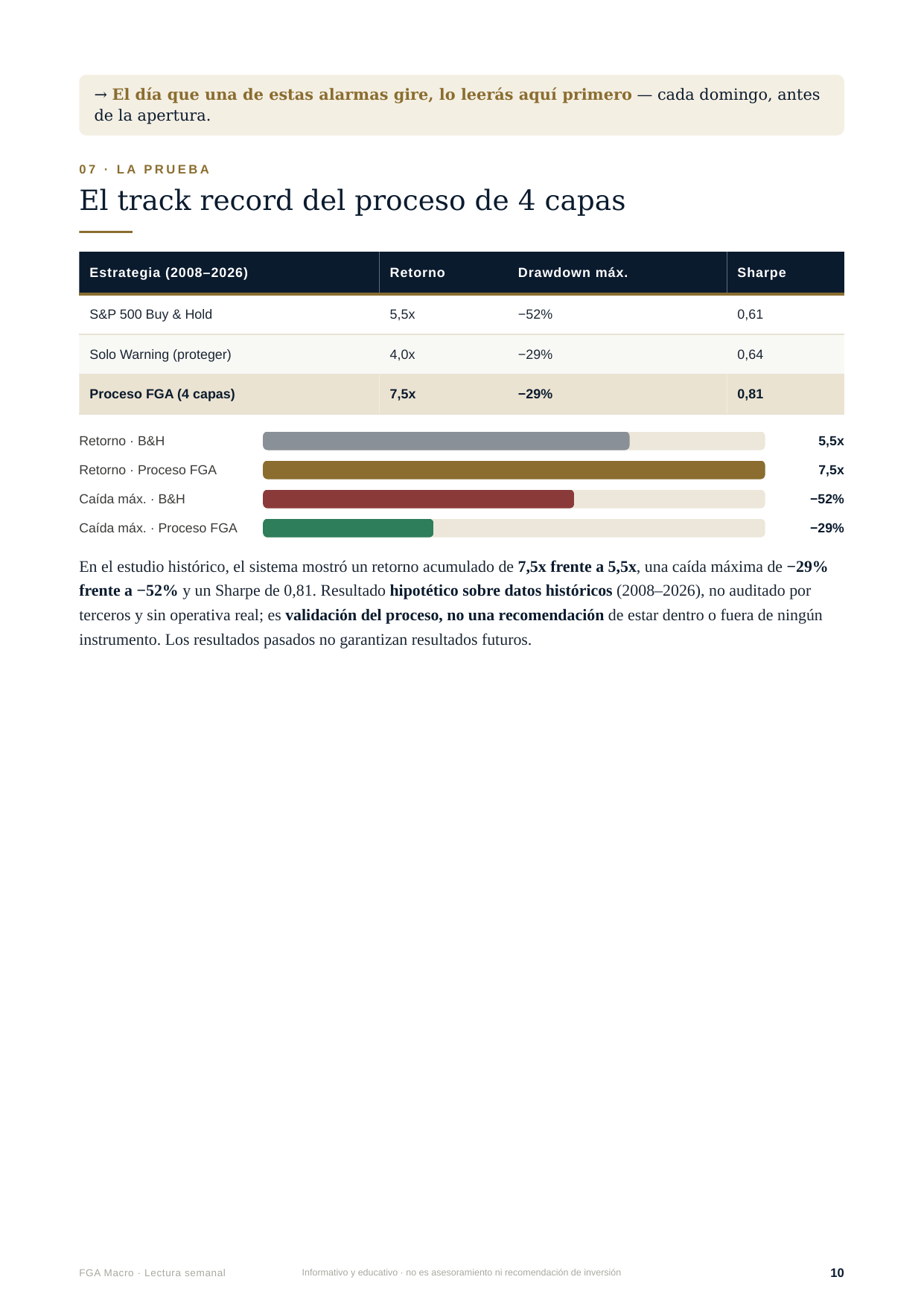
The methodology and the 33-year backtest are published and verifiable: Evidence — the proof is open →
How is this read built, layer by layer? It's in the Edition Zero →; and last week, in The leading indicator confirms the turn →.
And this week, our read of the BIS report on extreme valuation: AI bubble? What the BIS warns →.
You don't need to predict the top. You need to know which phase of the cycle you're in — and to be flagged the day it changes. It works for a portfolio and it works for a business: the cycle regime is the same backdrop when you decide when to invest, expand, hire, take on inventory or finance.
Subscribe free and get the cycle read every Sunday, before the open. Early subscribers get founder terms.
Reading this from an investment committee?
FGA Research distributes, on demand and subject to prior qualification, its Institutional Macro & Markets Report: the same four-layer process, with the full proprietary series and watchlist. If you run capital, manage risk or build strategy for a committee, write to us stating your role and mandate. We confirm eligibility and send the full report within 24h.
Information, not advice. Independence. Capital. Conviction.
About the author. Francisco Salvador, founder of FGA Research. The four-layer process has served the institutional sector for years; here we open it to the non-institutional reader —investors and business owners who decide with the cycle in front of them. I comment on the cycle every week on LinkedIn → Francisco Salvador on LinkedIn
Notice. Informational and educational content: dissemination of proprietary macro indicators and cycle analysis, not a regulated investment service. It is not advice or a recommendation —general or personalised— nor buy/sell signals. Market data from public sources; proprietary indicators of FGA Research; past results —real or simulated— do not guarantee future results; investing carries risk, including total loss of capital.
Independence. Capital. Conviction. · FGA Research & Advisory · Est. 2006 · 33 years of study
📄 The full weekly report — page by page