

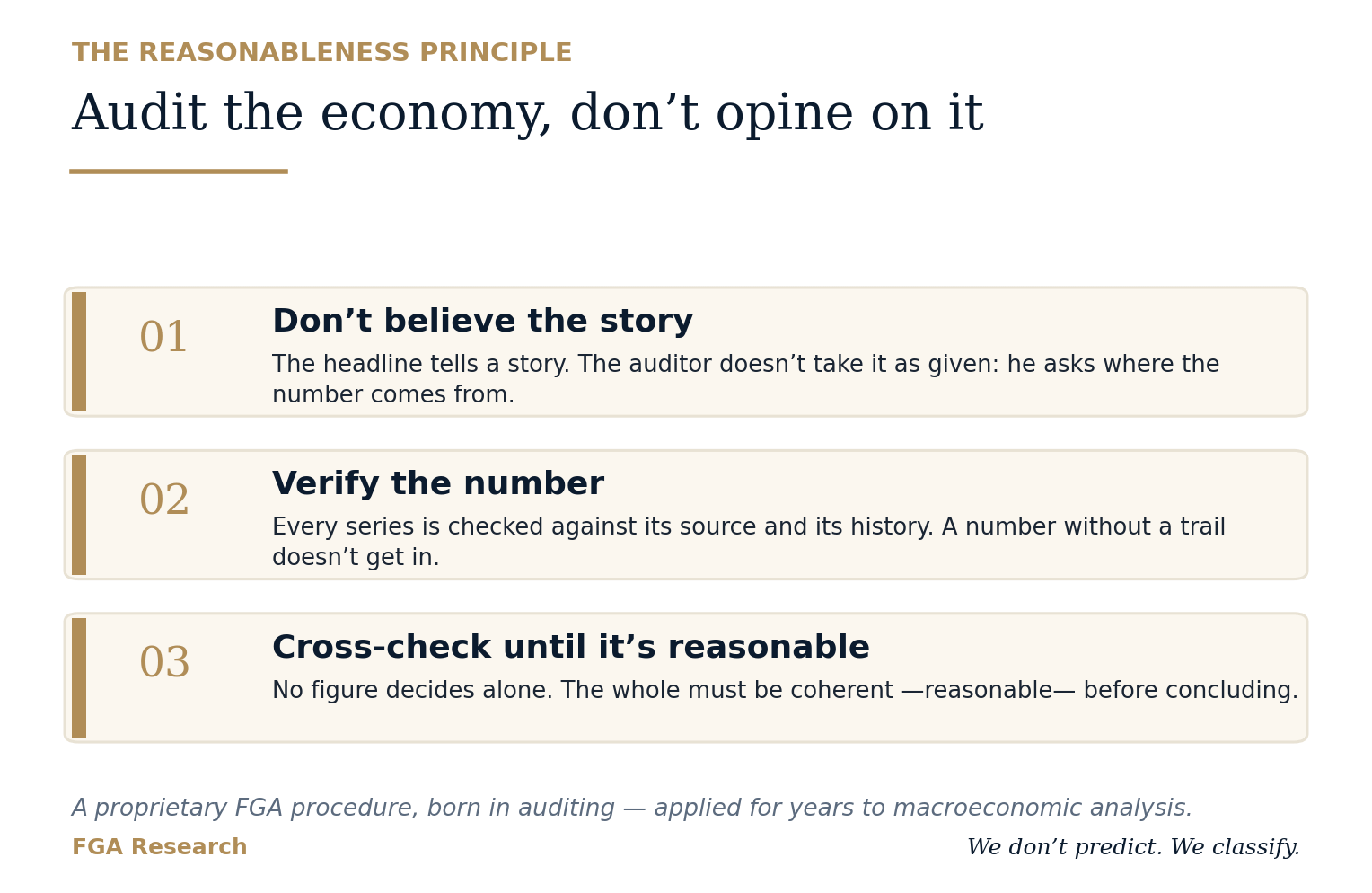
The reasonableness principle applied to the economy is FGA’s own procedure: treat every macro data point the way an auditor treats an account. Don’t believe the story, verify the number, and cross-check sources until the whole is reasonable. Francisco Salvador has called it that for years — and it is what separates auditing the economy from opining on it.
Most macro analysis in circulation is well-written opinion: someone reads a headline, frames it in a narrative and publishes. It sounds convincing. But a narrative is not a verified fact, and in markets that difference costs money.
It wasn’t born in statistics. It was born in auditing.
FGA’s process didn’t start in an econometric model. It started in auditing — Arthur Andersen —, where the first lesson is uncomfortable: the auditor doesn’t believe what he’s told; he verifies the number. No matter how coherent management’s explanation sounds: if the figure doesn’t reconcile with its source and its history, it doesn’t get in.
Carrying that discipline into macroeconomics is the reasonableness principle. We don’t ask "which narrative fits today?"; we ask "is this data reasonable in light of everything else?". It’s a boring, slow, distrustful way of looking — and that’s why it works.
Auditing macro demands what almost nobody has
The reasonableness principle is not a slogan: it sets a very high bar. To truly verify and cross-check you need four things that can’t be improvised:
Exceptional command of series and data. Auditing means comparing every series against its source and its history. That ability to handle large volumes of economic series placed Francisco, according to Bloomberg, at the level of the major international consultancies in Spain. It’s not showing off data: it’s the precondition for being able to verify it.
Deep knowledge of markets and their institutions. A macro figure can’t be understood without knowing how a central bank, a trading desk or a credit cycle work from the inside. Two and a half decades in the sector — banking, asset management, brokerage — give the context a model can’t see.
Proven multisector experience. Decades analysing a huge variety of sectors and companies teach you to separate the structural problem from cyclical noise. The same eye that audits a company audits an economy.
And from all of it comes the only thing that matters: the capacity to anticipate. When you verify the leading indicators instead of reacting to the coincident ones, the turn is visible before it becomes a headline. It’s not predicting the future — it’s classifying the present with enough rigor that the future holds fewer surprises.
From reasonableness to the four layers
FGA’s four-layer framework —the Warning, the Crowd, Money/the Fed and FGA Macro— is simply the reasonableness principle turned into a process: four independent readings crossed until the whole is coherent. None decides alone. The regime only changes when the weight of evidence makes it reasonable.
The best part: this now reaches the retail investor
For years, this rigor —auditing macro, mastering the series, anticipating the turn— was a service for institutional investors. What changes with FGA Macro is access: the same process, the same discipline, published openly every week so the individual investor can also read the cycle with institutional-grade judgment. Free, in Spanish and English.
In 30 seconds
🟢 Reasonableness principle = audit the economy, don’t opine on it.
🟡 It demands rare command of series, inside knowledge of markets, and decades across sectors.
🔴 Its fruit is anticipation — and now, via Substack, it’s within the retail investor’s reach.
Every week we classify the market regime with this rigor and publish it —dated, before the outcome is known— in FGA Macro.
The full framework is in The FGA Method; and the firm, with its two tracks —Research and AI & Advisory—, at fgaresearch.com.
Informational and educational content. Not financial advice, not a buy or sell recommendation, and containing no signals or price targets. FGA Research & Advisory. Francisco Salvador is an agent of Miraltabank, an entity regulated by the Bank of Spain.
Independence. Capital. Conviction. · FGA Research & Advisory · Est. 2006 · 33 years of study