

The question almost every business owner asks today isn’t “which AI do I buy?” It’s “where do I start, and whom do I trust so I don’t waste a fortune on hype?” The answer starts with the data, not the technology.
Artificial intelligence is the next industrial revolution. And like every industrial revolution, it rewards not who spends most on machines, but who decides well what to automate, and in what order. At FGA we have worked with AI since 2001 —we founded one of the first Spanish firms doing AI-based analysis— and one thing hasn’t changed in 25 years: the technology is the easy part. The decision is the hard part.
The problem isn’t AI. It’s the command room.
Almost every SME we work with arrives with the same sentence: “we have all the information; what we don’t have is a way to decide with it.” Thirty years of sales records in folders, the business intelligence living in the director’s head, and every opportunity depending on someone remembering in time. It’s not a software problem. It’s a method problem.
A real case, anonymised
A Spanish B2B supply company: three decades in the market, tens of thousands of SKUs, a book built on craft. Healthy, profitable —and with an invisible ceiling. Before proposing anything, we did what an auditor does: digitise the full sales archive and verify it document by document. What surfaced wasn’t visible from the inside:
Nine out of ten inbound contacts had no scheduled next step.
Six out of ten lost customers never received a proposal after their last purchase. They didn’t leave: they stopped being called.
A contract renewed for seven years with “the same” had lost almost half its price.
None of these findings was an AI problem. They were focus and process problems — the ones AI amplifies if you don’t fix them first.
What changed (and what didn’t)
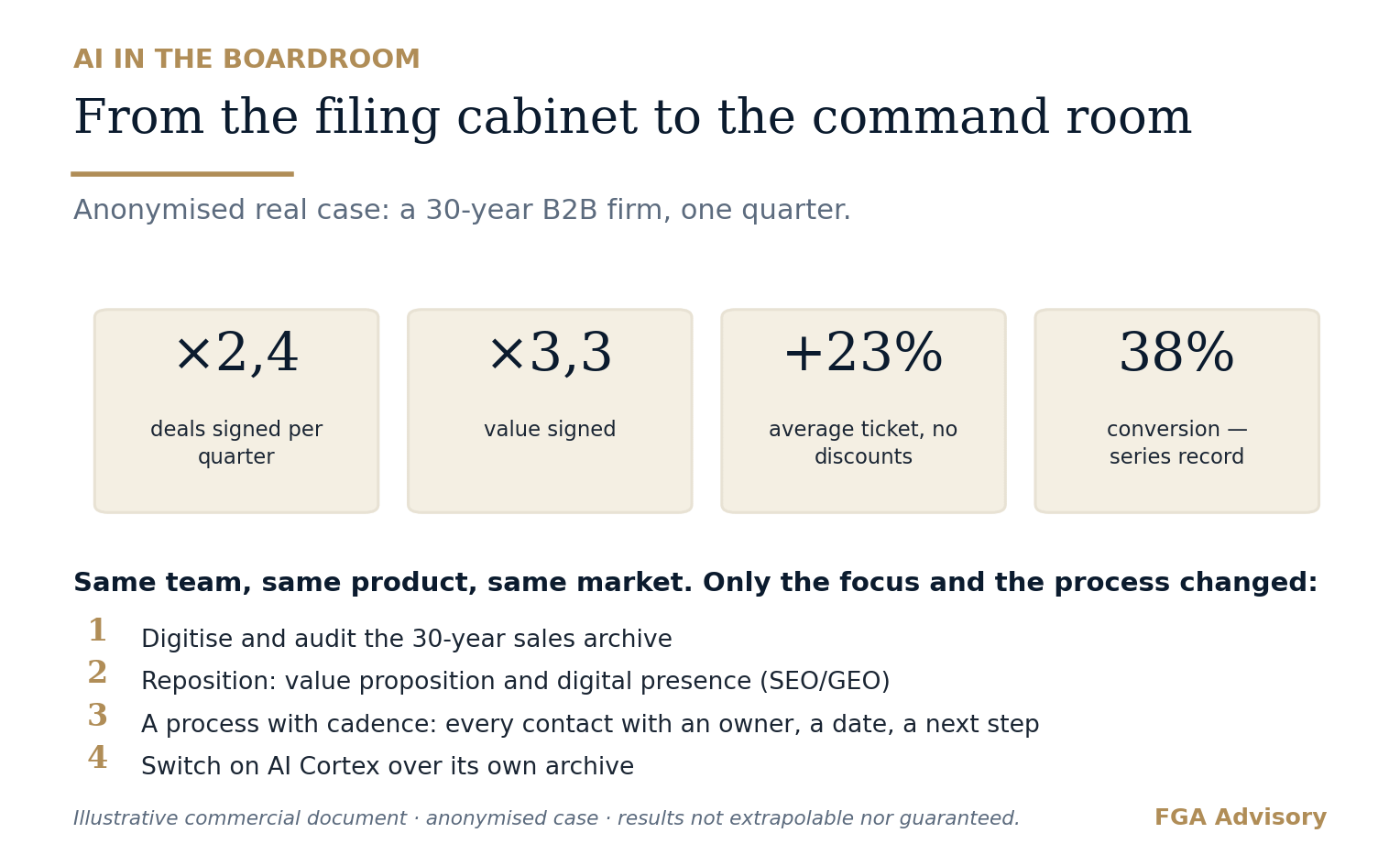
The first phase wasn’t technology: it was repositioning the business. A clear value proposition; digital presence that shows up when the client searches —also when they ask an AI—; a sales process with cadence where every contact has an owner, a date and a next step; and the archive digitised and verified as raw material. Only then did we switch on the AI (our Cortex engine) over its own archive.
Same team, same product, same market. In one quarter: 2.4× the deals signed, 3.3× the value signed, +23% average ticket with no discounts, 38% conversion —a series record. (Illustrative and anonymised case; results not extrapolable nor guaranteed.)
Order matters: data first, AI after
The lesson for a board is uncomfortable and liberating at once: AI doesn’t fix a business; it multiplies the one you already have. If the process is broken, AI multiplies the mess. If the archive isn’t verified, AI learns from dirty data. That’s why we audit before we automate — the same reasonableness principle we apply to macro, applied to your company: we don’t believe the story, we verify the number.
In 30 seconds
🔴 AI is a board-level decision, not a technology purchase.
🟡 Data first (audited), then process, and only then AI.
🟢 Well ordered, the effect multiplies; badly ordered, it amplifies the problem.
FGA Advisory guides boards and management teams through that decision: an AI implementation strategy with method and evidence, from the “AI in the Boardroom” white paper to the real case. Demonstrated vision since 2001, not hype opportunism.
Informational and commercial content. Illustrative and anonymised case; results not extrapolable nor guaranteed. FGA Research & Advisory · Est. 2006.
Independence. Capital. Conviction. · FGA Research & Advisory · Est. 2006